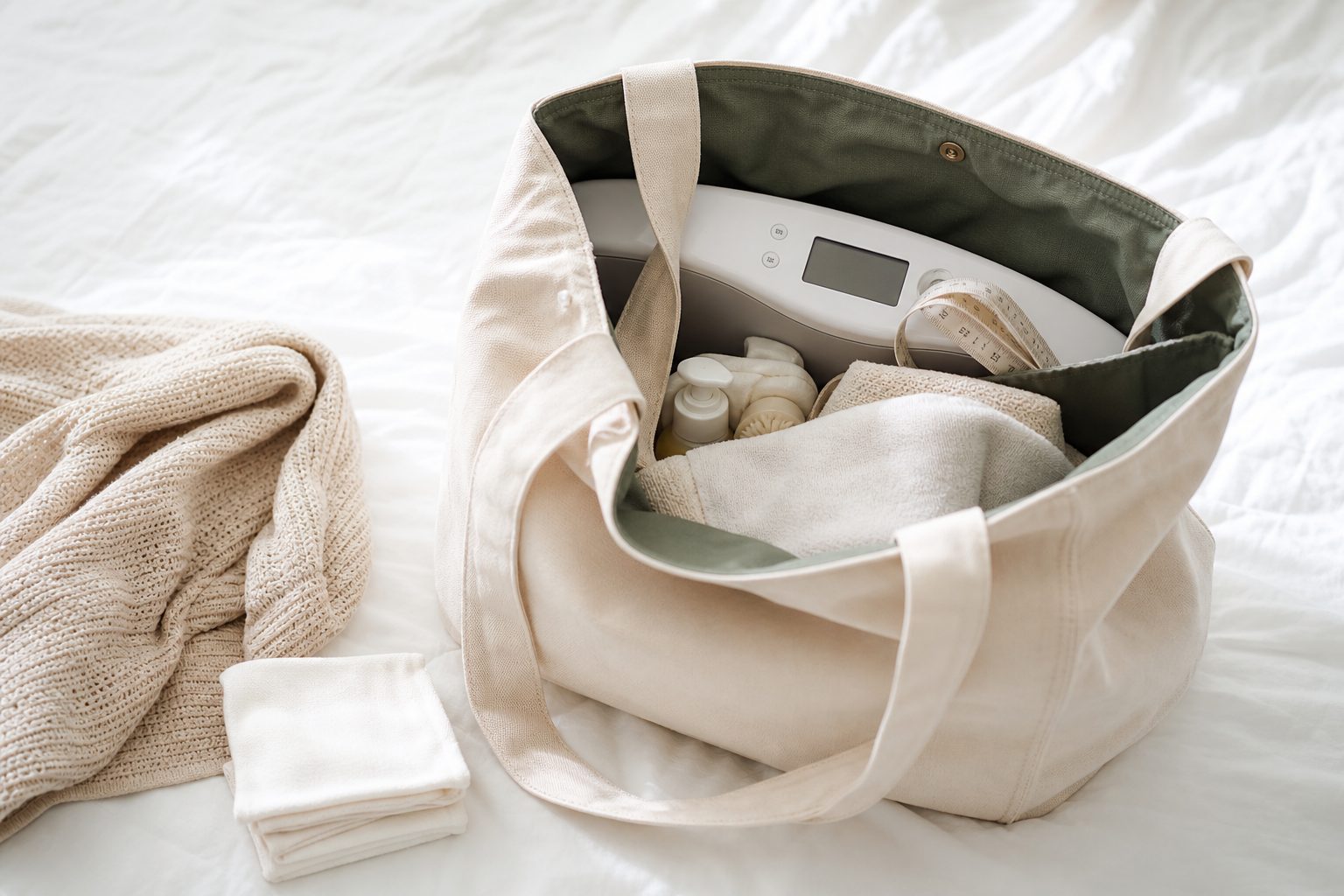
Your visit bag needs to do three jobs: measure accurately, fit any parent and baby you meet, and arrive at the next house as clean as it left this one. That means a class III digital infant scale you transport in a padded case, a full range of flange sizes from roughly 13 mm to 27 mm with a caliper or printed sizing guide, supplemental feeding supplies you can hand over on the spot, and a two step cleaning routine of detergent wash followed by a hospital grade disinfectant with a stated wet contact time.
Everything else is negotiable. The scale and the disinfection routine are not, because those are the two places where a home visit practice can genuinely cause harm: a scale that reads low sends a family to the emergency department for nothing, and a flange carried between two newborns without proper reprocessing is a transmission route you own.
What follows is the working kit, item by item, with the reasoning behind each choice and the routine that keeps it defensible.
The scale: accuracy class, calibration, and transport
Weighted feeds are the single most consequential measurement you take. A pre and post feed weight difference of 30 grams is roughly one ounce of milk transferred. If your scale drifts by 10 grams, you have mis-stated intake by a third.
Buy a scale rated for two gram increments or finer, and look for one described as legal for trade or approved to a recognized accuracy class. Consumer bathroom-style baby scales that round to half an ounce are not adequate for test weights. You want grams, because grams give you resolution that ounces hide.
Calibration you can actually document
Carry a set of certified calibration weights, or at minimum two known masses you have verified once against a certified scale. A 500 gram and a 2 kilogram weight cover the useful range. Check the scale at the start of every working week and write the reading in a log with the date. If it reads outside tolerance, recalibrate per the manual and re-check before the first visit.
Zero the scale after it has been placed on the surface you will actually use, not on your kitchen counter. Carpet is the enemy. A rigid board carried in the bag, laid on the floor with the scale on top, removes an entire category of argument about whether the reading was real.
Transport
Load cells do not enjoy being thrown into a trunk. A hard case or a padded sleeve, and the scale carried flat rather than on edge, extends its working life considerably. If you sling it loose in a tote you will be buying a replacement sooner than the warranty suggests.
Keep reading: How is insurance coverage for lactation care changing, and what should I plan for next year?
Flange sizing sets and single use versus reusable items
Nipple diameter varies far more than the 24 mm default shipped with most pumps. A sizing set that spans small through large, with the in between sizes that manufacturers sell separately, is what lets you solve a pain complaint in the room instead of ordering and waiting.
Split your kit clearly into two piles, and store them in physically separate pouches so a tired brain at the end of a long day cannot mix them.
- Demonstration only, never contacting the parent: sizing rulers, calipers, flange samples used to hold up against a measurement, a doll or model for positioning.
- Contact items, reprocessed or discarded: anything that touches skin, milk or a baby's mouth.
The honest position for most solo practices is that flanges which touch a parent go home with that parent or go in the trash. Reprocessing a flange to a standard you could defend if challenged requires cleaning and high level disinfection you are not going to do reliably in a car between two houses. Price a set of demonstration flanges into your fee and hand the used one over.
Supplemental feeding supplies worth stocking
The supplies that earn their space are the ones that let a plan begin today rather than after a pharmacy trip.
| Item | Why it travels | Handling |
|---|---|---|
| Feeding tube supplementer sets | At breast supplementation starts immediately | Single use, leave with family |
| Curved tip syringes, 10 mL | Colostrum feeds and finger feeding | Single use, sterile packaged |
| Nipple shields, multiple sizes | Sizing is the whole point of carrying a range | Sterile packaged, one leaves with family |
| Collection bottles and storage bags | Expressed milk needs somewhere to go | Single use |
| Small paper measuring cups | Cup feeding demonstration and volumes | Disposable |
| Nonsterile gloves | Oral assessment, any milk contact | Box in the bag, changed per visit |
| Hand sanitizer, at least 60 percent alcohol | Sinks are not always available | Two bottles, one in the car |
Keep a written count of each line. Running out of 10 mL syringes on a Friday afternoon visit is a self-inflicted wound.
Keep reading: What does a full day of back to back home visits really look like across a metro area?
Cleaning and disinfection between homes
The sequence matters more than the product. Disinfectant applied to a soiled surface does not work, because organic material blocks contact with the surface underneath. Clean first, then disinfect.
- Glove up. You are handling contaminated equipment, not tidying.
- Wipe visible soil from the scale tray, the board, the tape measure and the bag base with a detergent wipe. Discard.
- Apply a disinfectant registered for healthcare surfaces, with a label claim that covers the organisms you care about.
- Honor the wet contact time. Read the label. If it says four minutes, the surface must stay visibly wet for four minutes. One wipe and a quick dry is theater. Use a second wipe if the first dries early.
- Let it air dry or wipe with a clean cloth only if the label permits, then remove gloves and sanitize your hands.
Check that the disinfectant is compatible with your scale's surface. Some quaternary ammonium products haze plastics over months; a few alcohol formulations craze them faster. The manual usually names an acceptable class.
The bag itself
Choose a bag with a wipeable interior or a removable liner. A canvas tote that has absorbed spilled milk cannot be disinfected, only laundered, so it needs to be launderable at a hot wash. Set the bag down on a hard surface in the home, never on carpet or a bed, and keep a folded disposable pad in the outer pocket to set it on.
What to leave behind with the family and what to charge for
Decide this once and put it on your fee schedule, because renegotiating on a doorstep is exhausting.
A defensible default: consumable supplies used during the visit are included in the visit fee, and anything the family keeps that has a real unit cost is either included in a stated supply allowance or billed at cost plus a handling margin.
Worked example. Suppose you include a supply allowance of $18 in a $275 first visit fee. A visit that uses one supplementer set at roughly $9, two syringes at about $1 each, and a shield at about $8 comes to $19. You absorb the dollar. A visit that also needs a full flange pair at $22 exceeds the allowance, and that pair gets itemized on the invoice. The rule is simple to say out loud: what you used today is covered, what you keep and reuse is billed.
Write the leave-behind items into the plan the parent receives, so the record shows a shield was provided at a stated size and the family knows what they are holding.
See how LatchDesk handles this for lactation consulting
Cold weather, car storage, and equipment drift
Your car is not a supply closet. Most digital scales specify an operating range around 50 to 100 degrees Fahrenheit, and a scale that spent a January night at 15 degrees will read oddly until it equilibrates, which takes longer than the walk from the curb.
Bring the scale inside overnight. In summer, a parked car interior climbing past 130 degrees degrades adhesive labels, warps thin plastics and shortens battery life. Disinfectant wipes dry out in their tub. Alcohol sanitizer loses concentration over a hot season.
Practical rules that cost nothing:
- Scale and any liquid supplies come into the house every night, year round.
- Keep a spare set of batteries in a sealed bag, replaced on a fixed date twice a year.
- Allow the scale ten minutes at room temperature before the first weight of the day if it has been cold.
- Recheck calibration after any temperature extreme or any drop.
Restock and inspection routine after each day
Fifteen minutes at the end of the day prevents the panic that ruins a morning. Do it in the same order every time so it becomes automatic.
- Empty the contact-items pouch entirely. Discard anything opened.
- Clean and disinfect the scale, board, tape measure and bag base one final time.
- Count consumables against your par levels and restock to par from the home shelf.
- Inspect: cracked scale tray, frayed tape, cloudy shield packaging, expiry dates on sterile items.
- Charge or replace batteries if the low indicator appeared at all that day.
- Log the calibration check if it is the start of the week.
- Confirm every family from today has their written plan, then set the bag by the door.
Par levels are just a number you set once per item: enough for your busiest plausible day plus one. If you cap at four visits, hold five supplementer sets, ten syringes, and five shields per common size.
Where this leaves you
A visit bag is a small inventory system that travels at 55 miles per hour and gets opened in strangers' living rooms. Treat it that way and the rest of the practice steadies: your weights are trustworthy, your supplies are there, and nothing you carried into a home followed you out in a way you would not want to explain.
The last item on the list, the one families remember, is the plan itself. LatchDesk gives you visit templates for feeding assessment and weight checks, records the supplies you left behind at the sizes you left them, and texts the written plan to the parent before you have walked back to the car. Pack the bag once, and let the documentation close itself.